
In recent years, Dehradun has become home to many individuals living abroad. During the family reunification, embassies may ask for a DNA test report to further validate the sponsor-applicant’s family link. This is where immigration DNA tests in Dehradun become useful, especially when the primary visa documents, like birth certificates or other papers, are not sufficient for the immigration authorities. Such tests give visa officers clear evidence of a family bond, making the approval process smoother for everyone involved. Many local applicants now choose this route to avoid unnecessary delays.
The Need for Immigration DNA Tests
In every family reunification case, there are typically two individuals involved: one sponsor and one applicant. The embassy’s job is to confirm that these two people share the family bond they claim. Initially, the embassy officers usually check birth certificates, marriage certificates, and similar visa documents. However, it’s not always the case. Such documents are sometimes not ideal, as per the embassy’s requirements. Therefore, a DNA test report becomes mandatory.
Common Suspicions that May Lead to a DNA Test
- The birth certificate was never issued or has been lost
- The applicant and sponsor have different last names despite being related
- A birth was registered years after it actually took place
- The applicant had a visa application rejected in the past
- The submitted documents do not clearly show a family connection
The Process of DNA Testing for Sponsored Immigration
DNA tests in Dehradun, including all other areas, involve the following easy steps:
Step 1 – Scheduling an Appointment: The sponsor and applicant schedule an appointment at a lab for their DNA test. If both parties are living in different countries at the time of the test, the same lab coordinates the sample collection accordingly.
Step 2 – DNA Sample Collection: A lab expert gently rubs a soft cotton swab on the inside of the cheek walls. It’s a safe and painless procedure for individuals of all ages.
Step 3 – DNA Transportation: After obtaining the samples, they’re securely sealed to prevent tampering & contamination and sent to a lab for further processing.
Step 4 – Lab Analysis: Experts in the lab examine and compare the DNA samples to find the potential genetic match between individuals.
Step 5 – Final Report: After finishing the DNA analysis, a final report is generated, which is then sent to the tested party’s address.
Chain of Custody Procedure During Immigration DNA Tests
In some cases, the embassy may ask for a DNA report under a strict chain of custody procedure. In this process, an embassy-appointed official monitors the whole sample collection procedure. Before the sample collection, the official verifies the identities of the sponsor and applicant using their government-issued IDs. It’s to ensure that the right parties are present during the test.
Besides, the final report of a chain of custody procedure is sent directly to the embassy that requested the test. In this procedure, the final report isn’t sent to the tested party to maintain its privacy and integrity for its official admissibility.
Types of Family Links Verified During Sponsored Immigration
The following types of family links are verified to fulfill the diverse needs of the applicants:
Paternity – It verifies the genetic link between an alleged father and an alleged child.
Maternity – This confirms the biological ties between a mother and a child.
Siblingship – The genetic link between two or more siblings is confirmed using a DNA test.
Grandparentage – This test confirms the family link between a grandparent and a grandchild.
Avuncular – The family relationship of an uncle/aunt with their niece/nephew can be validated using a DNA test.
What Factors Influence the Cost of a DNA Test?
A DNA test cost depends on the following factors:
Number of People in the Test – The more individuals in a DNA test, the higher its cost will be. For instance, in a sponsored immigration, there is usually one sponsor and one applicant involved. However, if an additional applicant is also included, it’ll result in a higher cost of a DNA test, as the lab now has to analyze an additional sample.
Chain of Custody Procedure – If the applicant submits the DNA report voluntarily, it will cost less as it won’t involve any additional formalities. But if the embassy specially requests the DNA test under a chain of custody procedure, it’ll result in a higher cost. It’s because there will be additional formalities involved to make the report officially admissible.
Why Choose DDC Laboratories India for Immigration DNA Tests in Dehradun?
For a DNA test report to be officially admissible in the international embassies, the lab must hold certain accreditations. DDC Laboratories India holds accreditations from esteemed organizations like NATA, IRCC, AABB, and MOJ. With such accreditations, their DNA reports are officially admissible in international embassies like the United States, the United Kingdom, Canada, Australia, and other countries.
This makes them an ideal lab for immigration DNA tests in Dehradun, including all other cities in India. Besides, they also provide DNA testing services for peace of mind, non-invasive prenatal paternity, cell line authentication, discovery of the ancestral past, and more.
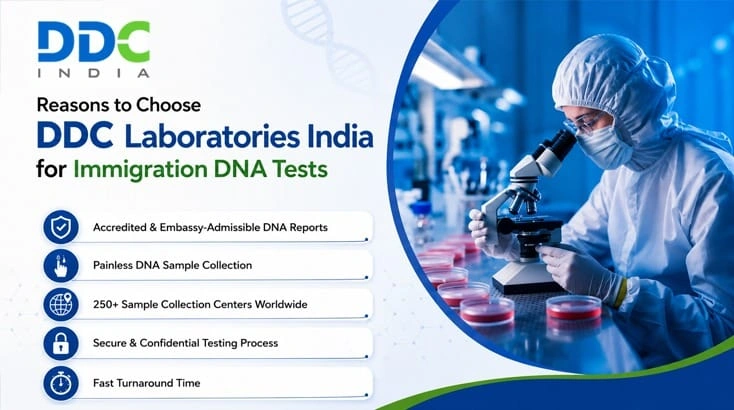
Choosing an accredited lab means the report is far less likely to be questioned or rejected by the embassy, which saves applicants both time and stress during an already lengthy visa process.
Final Words
Anyone in Dehradun preparing a sponsored visa application can benefit from planning ahead. Requesting the test before the embassy formally requests it can prevent delays and strengthen the authenticity of the visa application. A DNA testing appointment can be booked by calling the laboratory experts. They will also provide useful insights regarding the testing procedure.
Frequently Asked Questions
Q1. How long does it take to get the test results?
The turnaround time for the final report at DDC Laboratories India is typically around 4-5 business days.
Q2. Does the applicant need to inform the embassy before booking a DNA test?
It depends on the case. Some applicants choose to get tested before applying for a sponsored visa, while others test only after the embassy specifically requests it.
Q3. Are home sample collection kits available for immigration cases?
No. Immigration DNA tests require the sample to be collected by an authorized professional under proper identification checks, since the report must be officially admissible.
Q5. What happens to the DNA samples after the test is completed?
The samples are generally stored for a limited period and then disposed of following standard lab procedures. They are not used for any purpose beyond the requested relationship test.